Showing posts with label computation. Show all posts

Monday, December 19, 2016

the center of the universe

information is physical
Just a random thought:

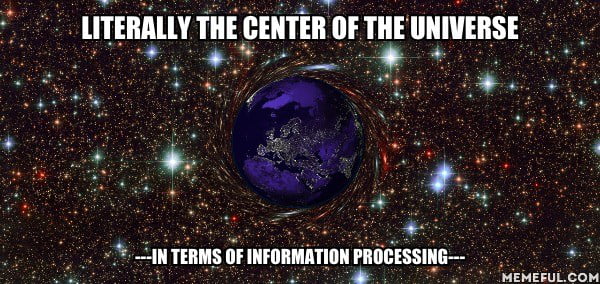
Earth is literally the center of the universe in terms of information processing.


Or at least, as far as we are aware of.

Because:

In the beginning, information processing manifested itself on molecular basis utilizing self-replicators a few billion years ago, as the emergent process called life unleashed itself.

Then, not too long ago, the neural networks assembled by the process of life became conscious and self-aware.

And currently, as these sentient beings bring information processing to a non-organic platform: binary computation.

Finally, as the cognizant beings push the limits of information processing into the quantum realm, employing the technology that emerged from their own information processing capabilities. This unlocks unprecedented new levels of computation.

--

Edit: made a meme out of this:


Thursday, May 26, 2016

more random quotes: scott aaronson

new perspectives
So, John Horgan, the End of Science guy, interviewed Scott Aaronson, a theoretical computer scientist interested in quantum computing and computational complexity theory.

In the following, some random quotes.

On Quantum Mechanics

    [Q]uantum mechanics is astonishingly simple—once you take the physics out of it!  In fact, QM isn’t even “physics” in the usual sense: it’s more like an operating system that the rest of physics runs on as application software.

    [A]ccepting quantum mechanics didn’t mean giving up on the computational worldview: it meant upgrading it, making it richer than before.  There was a programming language fundamentally stronger than BASIC, or Pascal, or C—at least with regard to what it let you compute in reasonable amounts of time.  And yet this quantum language had clear rules of its own; there were things that not even it let you do (and one could prove that); it still wasn’t anything-goes. 


The Computational Universe

    If it’s worthwhile to build the LHC or LIGO—wonderful machines that so far, have mostly triumphantly confirmed our existing theories—then it seems at least as worthwhile to build a scalable quantum computer, and thereby prove that our universe really does have this immense computational power beneath the surface. 

    Firstly, quantum computing has supplied probably the clearest language ever invented—namely, the language of qubits, quantum circuits, and so on—for talking about quantum mechanics itself.
[...]
Secondly, one of the most important things we’ve learned about quantum gravity—which emerged from the work of Stephen Hawking and the late Jacob Bekenstein in the 1970s—is that in quantum gravity, unlike in any previous physical theory, the total number of bits (or actually qubits) that can be stored in a bounded region of space is finite rather than infinite.  In fact, a black hole is the densest hard disk allowed by the laws of physics, and it stores a “mere” 1069 qubits per square meter of its event horizon!  And because of the dark energy (the thing, discovered in 1998, that’s pushing the galaxies apart at an exponential rate), the number of qubits that can be stored in our entire observable universe appears to be at most about 10122.
[...]
So, that immediately suggests a picture of the universe, at the Planck scale of 10^-33 meters or 10^-43 seconds, as this huge but finite collection of qubits being acted upon by quantum logic gates—in other words, as a giant quantum computation. 

The Big Picture

    Ideas from quantum computing and quantum information have recently entered the study of the black hole information problem—i.e., the question of how information can come out of a black hole, as it needs to for the ultimate laws of physics to be time-reversible.  Related to that, quantum computing ideas have been showing up in the study of the so-called AdS/CFT (anti de Sitter / conformal field theory) correspondence, which relates completely different-looking theories in different numbers of dimensions, and which some people consider the most important thing to have come out of string theory. 

    [S]ome of the conceptual problems of quantum gravity turn out to involve my own field of computational complexity in a surprisingly nontrivial way.  The connection was first made in 2013, in a remarkable paper by Daniel Harlow and Patrick Hayden.  Harlow and Hayden were addressing the so-called “firewall paradox,” which had lit the theoretical physics world on fire (har, har) over the previous year.

    In summary, I predict that ideas from quantum information and computation will be helpful—and possibly even essential—for continued progress on the conceptual puzzles of quantum gravity. 


    If civilization lasts long enough, then there’s absolutely no reason why there couldn’t be further discoveries about the natural world as fundamental as relativity or evolution. One possible example would be an experimentally-confirmed theory of a discrete structure underlying space and time, which the black-hole entropy gives us some reason to suspect is there. 

P/NP

    [T]he ocean of mathematical understanding just keeps monotonically rising, and we’ve seen it reach peaks like Fermat’s Last Theorem that had once been synonyms for hopelessness.  I see absolutely no reason why the same ocean can’t someday swallow P vs. NP, provided our civilization lasts long enough.  In fact, whether our civilization will last long enough is by far my biggest uncertainty. 

    More seriously, it was realized in the 1970s that techniques borrowed from mathematical logic—the ones that Gödel and Turing wielded to such great effect in the 1930s—can’t possibly work, by themselves, to resolve P vs. NP.  Then, in the 1980s, there were some spectacular successes, using techniques from combinatorics, to prove limitations on restricted types of algorithms.  Some experts felt that a proof of P≠NP was right around the corner.  But in the 1990s, Alexander Razborov and Steven Rudich discovered something mind-blowing: that the combinatorial techniques from the 1980s, if pushed just slightly further, would start “biting themselves in the rear end,” and would prove NP problems to be easier at the same time they were proving them to be harder!  Since it’s no good to have a proof that also proves the opposite of what it set out to prove, new ideas were again needed to break the impasse. 


Musings

    This characteristic of quantum mechanics—the way it stakes out an “intermediate zone,” where (for example) n qubits are stronger than n classical bits, but weaker than 2n classical bits, and where entanglement is stronger than classical correlation, but weaker than classical communication—is so weird and subtle that no science-fiction writer would have had the imagination to invent it.  But to me, that’s what makes quantum information interesting: that this isn’t a resource that fits our pre-existing categories, that we need to approach it as a genuinely new thing. 

    [I]f scanning my brain state, duplicating it like computer software, etc. were somehow shown to be fundamentally impossible, then I don’t know what more science could possibly say in favor of “free will being real”!


    I hate when the people in power are ones who just go with their gut, or their faith, or their tribe, or their dialectical materialism, and who don’t even feel self-conscious about the lack of error-correcting machinery in their methods for learning about the world.

    Just in the fields that I know something about, NP-completeness, public-key cryptography, Shor’s algorithm, the dark energy, the Hawking-Bekenstein entropy of black holes, and holographic dualities are six examples of fundamental discoveries from the 1970s to the 1990s that seem able to hold their heads high against almost anything discovered earlier (if not quite relativity or evolution).

Wednesday, January 27, 2010

complex systems update

scientific

complex systems are composed of many interconnected parts and cannot be tackled analytically, i.e., by using closed-form mathematical expressions. complex systems come from many domains:
  • socio-economic
  • technological
  • biological
Complex systems are often represented by networks; source.
they are typically characterized by non-linear behavior, display emergence ("the whole is greater than the sum of its parts") and are highly adaptive.

complex systems can be viewed as the current frontier in the understanding of the workings of nature, which started with the analysis of liner systems described by few variables:

(source: s. strogatz; "nonlinear dynamics and chaos"; 2001)

there are arguably two main strands in the study of complex systems:
  1. complexity science or complex adaptive systems
  2. multi-agent systems
the former fields find their moder incarnation mostly in the form of complex network theory, where the system's elements are represented by nodes in a graph, and their interactions are defined by the graphs edges. complex networks can have three levels of description:
  1. direction of links
  2. weights of links
  3. variables assigned to nodes
the topology of the network often reflects its function.

multi-agent systems originate from the computational approach of agent-based modeling. agents interact with each other through local rules. often the evolution of these systems can only be known by letting the actual simulation evolve.


(source: wikipedia, complexity map overview)

slowly however, the focus has shifted on merging the two strands. in may 2010 there will be a workshop on "emergent intelligence on networked agents". from the description:

the intention of this workshop is to [bridge] the gap between the two research communities in complex networks and multi-agent systems.
currently, it seems that research on multi-agent systems is still mostly focused on agents themselves, whereas networks of agents have received relatively little attention.
a framework to model these multi-agent systems is provided by the complex networks approach [...]. thus, the underlying network structure of a multi-agent system plays a crucial role in explaining emergent properties. networked agents, on the other hand, may be able to actively change this structure by forming new links or cutting existing ones. consequently, there is not only a strong relation, but a coevolution in the dynamics of agents and their network of interactions.